VOIP.GE TECHNICAL DOCUMENTATION
SIP Protocol & Configuration
Session Initiation Protocol (SIP) is the primary signaling protocol used to establish, modify and terminate real-time communication sessions across IP networks.
SIP is responsible for signaling and session control. The actual voice media is normally transported independently using RTP, while SDP describes the media capabilities and negotiated session parameters.
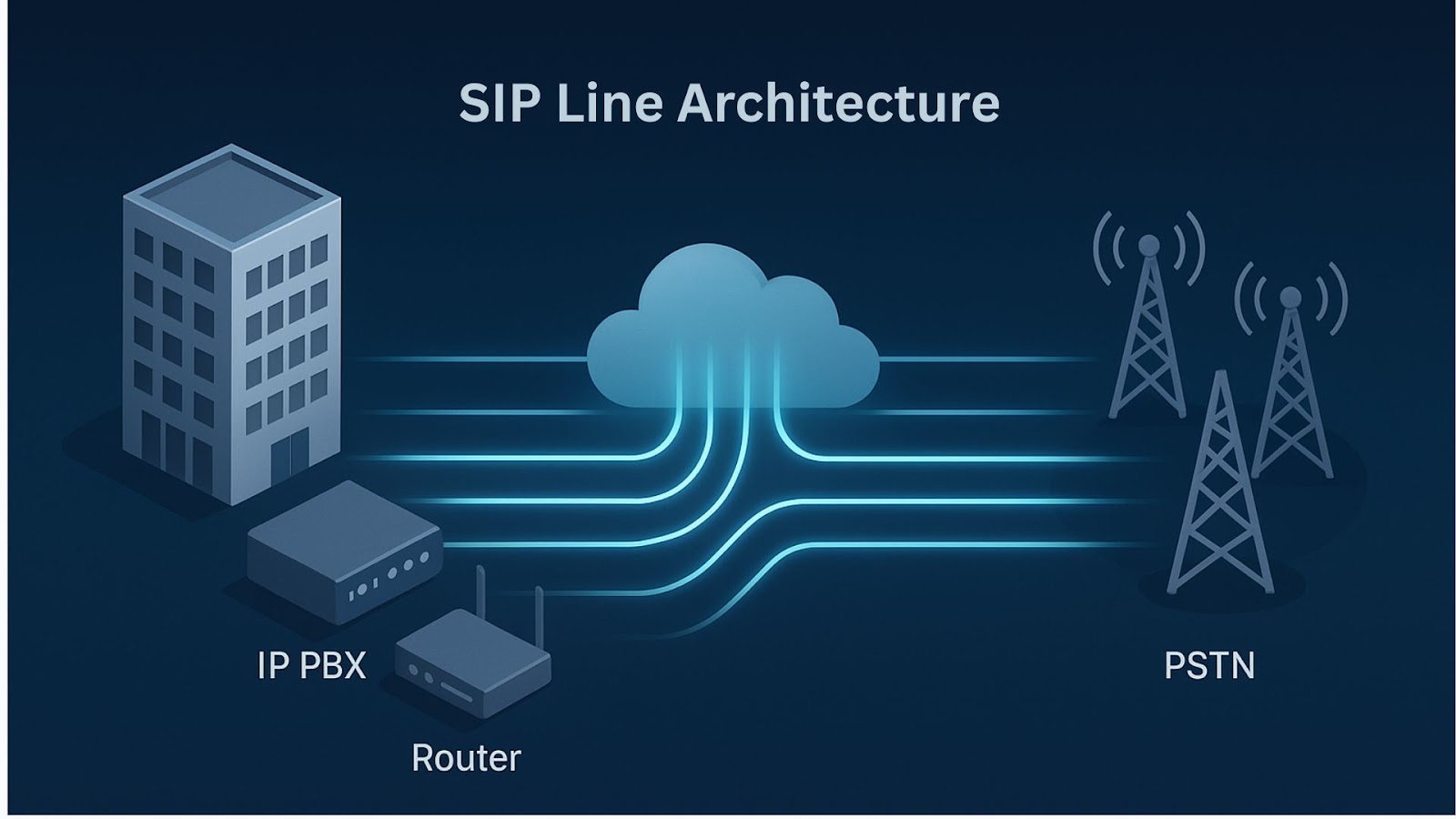
PROTOCOL ARCHITECTURE
SIP Communication Architecture
SIP separates signaling from media transport. This distinction is fundamental when troubleshooting VoIP systems.
SIP Signaling
SIP messages control session establishment, modification, registration and termination.
SDP
Session Description Protocol describes codecs, RTP ports, IP addresses, media directions and other session parameters.
RTP
Real-time Transport Protocol normally carries the actual audio stream after the SIP session has been established.
RTCP
RTP Control Protocol provides information associated with media delivery and quality monitoring.
SIP SIGNALING
SIP Methods
SIP uses request methods to communicate session and registration operations between user agents, proxies, registrars and other SIP entities.
INVITE
Initiates a new SIP session or establishes a new dialog.
ACK
Confirms receipt of a final response to an INVITE transaction.
BYE
Terminates an established SIP dialog.
CANCEL
Terminates a pending INVITE transaction before the session is established.
REGISTER
Associates a SIP Address-of-Record with a reachable contact address at a registrar.
OPTIONS
Used to query capabilities and determine whether a SIP endpoint or service is reachable.
REFER
Used for SIP call transfer and referral operations.
INFO
Provides a mechanism for carrying additional application or signaling information within an established SIP dialog.
CALL FLOW
Basic SIP Call Flow
A typical SIP call consists of several signaling transactions before media is exchanged.
1. INVITE
The originating endpoint sends an INVITE containing session information and SDP.
2. 100 Trying
Indicates that the request has been received and processing has started.
3. 180 Ringing
Indicates that the destination endpoint is being alerted.
4. 183 Session Progress
Can provide early media information before final call acceptance.
5. 200 OK
Indicates successful acceptance of the INVITE and normally contains the final SDP offer or answer.
6. ACK
Confirms the final response and completes establishment of the INVITE transaction.
7. RTP
Voice media is exchanged according to the negotiated SDP parameters.
8. BYE
One endpoint terminates the established session.
SIP MESSAGE STRUCTURE
Important SIP Headers
Understanding SIP headers is essential when analyzing traces from IP phones, PBX systems, SBCs and SIP providers.
Via
Records the transport path used by SIP requests and is important for response routing and transaction processing.
From
Identifies the logical originator of the SIP request.
To
Identifies the logical destination of the SIP request.
Call-ID
Provides a globally unique identifier for a SIP dialog or call relationship.
CSeq
Associates requests with sequence numbers and helps maintain transaction ordering within a dialog.
Contact
Provides the URI through which the endpoint can subsequently be reached for dialog-related requests.
Route / Record-Route
Controls and preserves signaling paths through SIP proxies and intermediate network elements.
User-Agent
Identifies the SIP implementation or endpoint software generating the request.
MEDIA NEGOTIATION
SDP — Session Description Protocol
SIP establishes the signaling session, while SDP describes how the media session should operate.
Connection Address
SDP specifies the network address associated with the media session.
RTP Port
The media description identifies the UDP port where RTP packets are expected.
Codec List
SDP advertises supported codecs and their payload types.
RTP Profile
The media profile indicates how RTP is expected to transport the negotiated media.
Media Direction
SDP can indicate whether media is sendrecv, sendonly, recvonly or inactive.
Codec Parameters
Additional codec-specific attributes can be exchanged using SDP attributes.
AUDIO CODECS
VoIP Codecs
Codec selection affects bandwidth, packetization, CPU utilization, voice quality and interoperability.
G.711 μ-law
Commonly used in North American telephony environments and provides uncompressed PCM-quality voice.
G.711 A-law
Widely used in European and international telecommunications environments.
G.722
Wideband codec capable of providing higher perceived voice quality than narrowband telephony codecs.
G.729
Low-bandwidth codec historically used in constrained WAN environments.
Opus
Modern adaptive codec supporting a broad range of bitrate and latency requirements.
Codec Negotiation
Both endpoints must agree on a compatible codec before media can be exchanged successfully.
MEDIA TRANSPORT
RTP and RTCP
SIP signaling and RTP media are separate. A call can therefore have perfectly normal SIP signaling while the actual audio path is broken.
RTP
Carries real-time audio packets between negotiated media endpoints.
UDP Transport
RTP is normally transported using UDP because low latency is generally more important than retransmission.
RTP Port Range
The exact RTP port range depends on the endpoint, PBX, SBC or gateway implementation.
RTCP
Provides control and quality-related information associated with RTP streams.
Jitter
Variation in packet arrival time can cause audio distortion, buffering and increased latency.
Packet Loss
Lost RTP packets directly affect perceived voice quality.
TELEPHONY SIGNALING
DTMF Transmission
Dual-Tone Multi-Frequency signaling is used for digits entered during calls, including IVR navigation, authentication systems and automated telephone services.
RFC 4733
Sends telephone-event information as RTP events rather than relying on in-band audio transmission.
SIP INFO
Can transport DTMF-related signaling inside SIP messages depending on the endpoint and platform.
In-Band DTMF
DTMF tones are transported directly inside the audio stream.
Interoperability
Incorrect DTMF configuration is a common cause of IVR and automated service failures.
SIP REGISTRATION
SIP REGISTER
SIP registration allows an endpoint to inform a registrar where it can currently receive SIP requests.
User / Extension
Represents the logical identity associated with the SIP account.
Registrar
Maintains bindings between the Address-of-Record and current contact information.
Contact
Specifies the current reachable SIP endpoint address.
Expires
Defines the desired lifetime of the registration binding.
Authentication
SIP endpoints can be challenged using SIP authentication mechanisms, commonly Digest authentication.
Re-Registration
Endpoints periodically refresh their registration before expiration.
SECURITY
SIP Authentication
SIP authentication protects registration and other protected SIP operations from unauthorized access.
401 Unauthorized
A server can challenge the client for authentication credentials.
407 Proxy Authentication Required
A proxy can request authentication before processing the SIP request.
Digest Authentication
Credentials are verified using a challenge-response mechanism rather than transmitting the password as plaintext in the SIP message.
Strong Credentials
SIP credentials should be unique, sufficiently complex and never reused across unrelated systems.
NETWORKING
SIP and NAT
NAT is one of the most common sources of VoIP problems because SIP signaling and RTP media contain network addressing information that can become invalid when translated.
Private Addressing
SIP endpoints behind NAT commonly use RFC 1918 private addresses.
SIP Contact
Incorrect private addressing inside SIP headers can prevent inbound signaling from reaching the endpoint.
SDP Address
An SDP body can advertise a private media address that is unreachable from the external network.
Symmetric RTP
Symmetric media behavior can help endpoints operate through certain NAT environments.
STUN
Session Traversal Utilities for NAT can help an endpoint discover its public-facing network mapping.
SBC
A Session Border Controller can anchor signaling and media and provide controlled NAT traversal between SIP domains.
ROUTER / FIREWALL
SIP ALG
SIP Application Layer Gateway functionality modifies SIP signaling at the firewall or router layer. Although intended to assist NAT traversal, poorly implemented SIP ALG frequently causes interoperability problems.
Header Modification
ALG implementations may rewrite SIP headers and SDP information.
RTP Problems
Incorrect media rewriting can result in one-way audio or completely missing audio.
Registration Failures
Aggressive or incompatible ALG processing can interfere with SIP registration.
Recommended Approach
In professionally engineered VoIP networks, SIP handling should be explicitly designed rather than relying on unknown firewall ALG behavior.
ENCRYPTED VOICE
SIP TLS and SRTP
Secure VoIP requires protection of both signaling and media. Encrypting only one component does not provide complete end-to-end voice confidentiality.
SIP over TLS
TLS protects SIP signaling between participating network elements.
SRTP
Secure RTP provides encryption and integrity protection for supported real-time media streams.
Certificates
Certificate-based trust can be implemented using an appropriate PKI architecture.
5060 / 5061
UDP/TCP port 5060 is commonly used for SIP, while TCP/TLS port 5061 is commonly associated with SIP over TLS.
DIAGNOSTICS
SIP Response Codes
1xx — Provisional
Indicates that the request has been received and is being processed.
2xx — Success
Indicates successful processing of the SIP request.
3xx — Redirection
Indicates that additional action or another destination is required.
4xx — Client Error
Indicates a problem with the request or the requesting client.
5xx — Server Error
Indicates that the server encountered a condition preventing successful processing.
6xx — Global Failure
Indicates that the requested action is known to be impossible at the destination level.
TROUBLESHOOTING
Common SIP Errors
400 Bad Request
The receiving SIP element considers the request malformed or invalid.
401 Unauthorized
Authentication is required or the supplied credentials are not accepted.
403 Forbidden
The request was understood but access is not permitted.
404 Not Found
The requested SIP user or destination cannot be located.
408 Request Timeout
The transaction did not receive the required response within the expected period.
480 Temporarily Unavailable
The destination is temporarily unavailable.
486 Busy Here
The destination is reachable but currently cannot accept the call.
488 Not Acceptable Here
The session parameters are not acceptable to the destination.
500 Server Internal Error
The SIP server encountered an internal processing problem.
503 Service Unavailable
The SIP service is temporarily unable to process the request.
504 Server Time-out
The server did not receive a timely response from another SIP server.
603 Decline
The destination has explicitly indicated that the call should not be accepted.
MEDIA TROUBLESHOOTING
One-Way Audio and No Audio
One-way audio is normally a media-path problem rather than a SIP signaling problem. The SIP call can establish successfully while RTP packets are blocked or routed incorrectly.
NAT
Check whether the SDP contains private addresses that cannot be reached from the opposite side.
Firewall
Verify that the negotiated RTP/RTCP UDP port range is permitted.
SDP
Compare the connection address and media port advertised by both sides.
RTP Routing
Verify that the actual media path exists in both directions.
SBC
Confirm whether an SBC is anchoring or rewriting the media path.
Packet Capture
Wireshark or equivalent packet analysis can determine whether RTP packets are transmitted and received correctly.
ENGINEERING WORKFLOW
SIP Troubleshooting Methodology
VoIP troubleshooting should follow the signaling and media path systematically instead of changing configuration randomly.
01 — Registration
Verify whether the endpoint is successfully registered with the SIP registrar.
02 — INVITE
Confirm that the INVITE reaches the expected SIP server or provider.
03 — Response
Analyze provisional and final SIP responses to determine where the call is being rejected.
04 — SDP
Compare IP addresses, ports, codecs and media direction.
05 — RTP
Verify packet transmission in both directions.
06 — Network
Check routing, firewall rules, NAT, QoS and MTU behavior.
SECURITY ENGINEERING
SIP Security Best Practices
Restrict SIP Access
Accept SIP signaling only from trusted addresses and required network segments.
Protect Credentials
Never use predictable SIP passwords or reuse credentials across multiple systems.
Control Outbound Calling
Apply explicit dial-plan and authorization policies for international and premium-rate destinations.
Disable Unused Services
Remove unnecessary SIP accounts, trunks and management interfaces.
TLS
Use SIP over TLS where encrypted signaling is required and supported.
SRTP
Use SRTP when voice media requires encryption and integrity protection.
SERVICENET
SIP Services by ServiceNet
ServiceNet provides SIP-based communication infrastructure for businesses, PBX systems, IP telephony platforms and call-center environments.
SIP Trunk
Carrier-grade SIP connectivity for enterprise PBX and communication platforms.
SIP Accounts
SIP credentials for IP phones, software clients and supported telephony platforms.
DID Numbers
Telephone numbers for inbound communication and business applications.
SIP Integration
Integration with Cisco, Grandstream, Yealink, Fanvil and other SIP-capable systems.
PBX Integration
SIP connectivity for Asterisk, FreePBX, 3CX and enterprise communication platforms.
Technical Support
Assistance with SIP registration, routing, codecs, NAT, DTMF, signaling and interoperability.
VOIP.GE KNOWLEDGE BASE
SIP as the Foundation of IP Telephony
SIP is more than a protocol used to make telephone calls. It forms the signaling foundation of modern IP communication systems and provides the interoperability layer between endpoints, PBX platforms, SBCs, voice gateways and telecommunications providers.
Correct VoIP engineering requires separation of signaling, media and network transport. A SIP message can be completely correct while the RTP path is broken, and a successful registration does not guarantee that outbound calls, inbound calls, DTMF or media will operate correctly.
For this reason, SIP troubleshooting should always consider the complete communication path: endpoint → network → SIP signaling → SDP negotiation → RTP media → remote endpoint.
ServiceNet provides SIP connectivity and technical integration for business telephony, IP PBX systems, call centers, SIP trunks and enterprise communication infrastructure.
For technical consultation, use the contact options available on our website or call:
+995 322 485000
24/7 Technical Support