IP TELEPHONY TECHNOLOGY
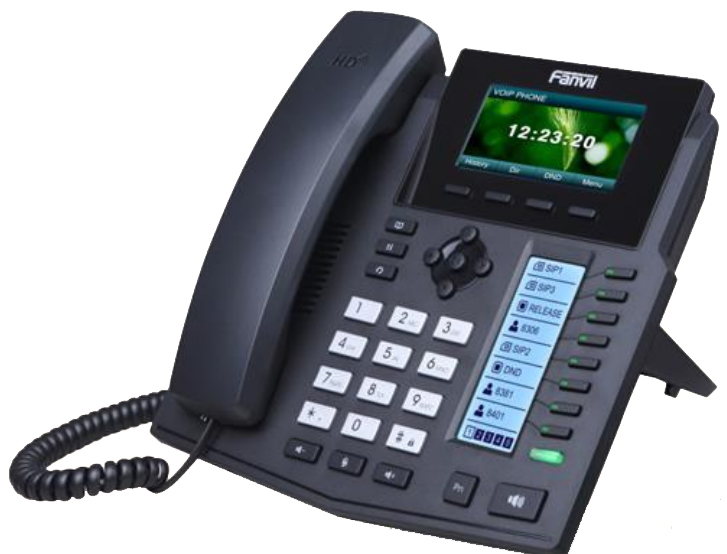
Fanvil IP Phones
Professional SIP endpoints designed for business telephony, call centers, hosted PBX platforms, intercom systems, paging infrastructure and specialized IP communication environments.
Fanvil combines standards-based SIP communication with extensive network functionality, PoE, VLAN, QoS, multicast, provisioning and specialized industrial communication features.
TECHNOLOGY OVERVIEW
Why Fanvil?
Fanvil provides a broad portfolio of SIP-based communication devices ranging from conventional desktop IP phones to advanced business, hospitality, intercom, paging and industrial communication endpoints.
This makes Fanvil particularly useful when a VoIP infrastructure requires more than a traditional office telephone.
Standards-Based SIP
Fanvil endpoints use SIP-based signaling and can integrate with IP-PBX, Cloud PBX and SIP service infrastructures.
Enterprise Networking
VLAN, QoS, LLDP, Ethernet and PoE features allow integration with managed network infrastructure.
Auto Provisioning
Centralized provisioning mechanisms simplify the deployment and management of large endpoint installations.
Multicast Paging
Selected Fanvil devices support multicast-based paging and public address communication.
Intercom
Specialized Fanvil devices can provide SIP-based door entry, intercom and access communication.
Wide Product Range
The product family covers office, hospitality, industrial, security and specialized communication applications.
SIP TECHNOLOGY
SIP Architecture
Fanvil endpoints operate as SIP User Agents and communicate with the IP-PBX, SIP proxy, registrar or hosted telephony platform using SIP signaling.
SIP Registration
The endpoint registers its SIP identity against the configured registrar.
Multiple SIP Accounts
Supported models can provide multiple SIP accounts for different extensions or services.
SIP Proxy
SIP signaling can be routed through a proxy or SBC according to the network architecture.
UDP / TCP / TLS
Supported SIP transport mechanisms include UDP, TCP and TLS depending on model and firmware.
RTP / RTCP
Real-time voice media is transmitted using RTP with RTCP available for media control and statistics.
DTMF
DTMF supports IVR navigation, feature codes, automated services and interactive applications.
AUDIO TECHNOLOGY
Voice Codecs
Codec selection directly affects voice quality, bandwidth consumption and interoperability between endpoints and the telephony platform.
G.711
A widely deployed telephony codec providing high compatibility and predictable voice quality.
G.722
Wideband speech codec designed for improved voice intelligibility in compatible deployments.
G.729
Designed for lower-bandwidth voice applications where supported by the endpoint and service platform.
Opus
Modern adaptive codec designed for high-quality voice and flexible network conditions where supported.
Codec Priority
Codec order should be explicitly planned to ensure predictable negotiation between endpoints and PBX systems.
Packetization
RTP packetization intervals affect bandwidth utilization, latency and voice processing overhead.
DEVICE MANAGEMENT
Fanvil Auto Provisioning
Large VoIP installations should not rely on manual configuration of every telephone. Fanvil provisioning mechanisms allow configuration to be centralized and automated.
HTTP / HTTPS
Configuration files can be retrieved from centralized provisioning servers.
TFTP
TFTP can be used in controlled environments where traditional provisioning infrastructure is required.
DHCP Option 66
DHCP provisioning mechanisms can provide the endpoint with the location of configuration resources.
SIP PnP
Supported environments can use SIP-based Plug and Play mechanisms for endpoint discovery and provisioning.
Configuration Templates
Standardized templates allow common SIP, network and feature parameters to be deployed consistently.
Mass Deployment
Automated configuration reduces installation time and minimizes human configuration errors.
NETWORK INTEGRATION
Fanvil Network Features
Fanvil endpoints are particularly suitable for managed IP networks where voice traffic must be isolated, prioritized and centrally controlled.
VLAN
Voice VLAN allows IP telephony traffic to be logically separated from workstation traffic.
IEEE 802.1Q
VLAN tagging allows the endpoint to participate in a standards-based Layer-2 segmentation architecture.
LLDP
LLDP enables network devices and endpoints to exchange information about their network environment.
LLDP-MED
LLDP-MED can assist with automated discovery and policy assignment for voice endpoints.
IPv4 / IPv6
Depending on the model, Fanvil devices support modern IP network addressing technologies.
DNS / NTP
DNS provides hostname resolution while NTP maintains accurate endpoint time synchronization.
POWER & ETHERNET
PoE and Ethernet
PoE simplifies IP phone deployment by combining network connectivity and electrical power over the same Ethernet infrastructure.
Power over Ethernet
Compatible endpoints can receive power directly from a PoE-enabled Ethernet switch.
Dual Ethernet Ports
Selected models provide two Ethernet interfaces, allowing a PC to connect through the phone.
Gigabit Connectivity
Gigabit Ethernet models can integrate into modern high-speed access networks.
Managed Switching
Combining the endpoint with a managed switch allows VLAN, QoS and security policies to be centrally enforced.
QUALITY OF SERVICE
QoS and Voice Traffic
Voice traffic requires deterministic network treatment. Bandwidth alone does not guarantee good voice quality.
DSCP
Layer-3 DSCP markings can be used to classify and prioritize RTP traffic throughout the network.
802.1p
Layer-2 priority information can be used by managed switches to prioritize voice traffic.
RTP Priority
Real-time RTP traffic should receive appropriate priority over less latency-sensitive traffic.
Jitter
Network jitter can produce interruptions and audio distortion during real-time communication.
Packet Loss
Packet loss directly affects speech quality and should be minimized through proper network engineering.
Latency
Excessive end-to-end delay can negatively affect natural conversation.
SECURITY
SIP Security
VoIP endpoints must be protected against unauthorized registration, credential theft, SIP scanning and interception of signaling or media.
SIP over TLS
TLS can encrypt SIP signaling between the endpoint and the telephony infrastructure.
SRTP
Secure RTP provides encryption and integrity protection for compatible voice media sessions.
HTTPS Provisioning
Secure provisioning protects configuration data while it is transferred to the endpoint.
Strong Credentials
Unique and sufficiently complex SIP credentials should be used for every endpoint.
Firmware Security
Firmware should be maintained according to the supported vendor release lifecycle.
Network ACL
Firewall and ACL policies should restrict SIP and RTP communication to trusted infrastructure.
SPECIALIZED COMMUNICATION
Multicast Paging and Intercom
One of Fanvil's practical advantages is its suitability for specialized IP communication systems beyond ordinary desk telephony.
Multicast Paging
Multicast can distribute audio announcements to multiple endpoints simultaneously without establishing individual SIP calls.
IP Intercom
SIP-based intercom devices can integrate door stations and communication points with the central telephony platform.
Door Communication
Compatible devices can be used for entrance communication and integration with IP telephony.
Public Address
Fanvil infrastructure can be used in distributed paging and public announcement environments.
Emergency Communication
Specialized SIP endpoints can provide dedicated communication points in controlled environments.
Hospitality
Fanvil's specialized product range can be applied to hotels, offices, campuses and commercial facilities.
DEPLOYMENT MODEL
Typical Fanvil Architecture
Access Switch
The endpoint connects to a managed Ethernet access switch.
PoE
Compatible devices receive electrical power through Ethernet.
Voice VLAN
Voice endpoints are placed inside the designated Layer-2 voice segment.
DHCP
DHCP provides IP addressing and can assist with provisioning.
Provisioning Server
The device receives its SIP and endpoint configuration automatically.
SIP Platform
The endpoint registers against the IP-PBX, SBC or hosted telephony platform.
APPLICATIONS
Fanvil Use Cases
Business Offices
Professional SIP phones for employees, reception desks and management.
Call Centers
SIP endpoints for agents and headset-based customer service environments.
Hotels
Specialized endpoints for rooms, reception, administration and hospitality infrastructure.
Warehouses
Paging and specialized communication endpoints for industrial environments.
Industrial Facilities
SIP intercom and communication endpoints for controlled industrial environments.
Multi-Site Networks
Centralized provisioning allows standardized deployment across geographically distributed locations.
SERVICENET ENGINEERING
Fanvil Deployment by ServiceNet
ServiceNet can integrate Fanvil endpoints into a complete VoIP architecture including SIP Trunk, Cloud PBX, Virtual PBX, provisioning and managed network infrastructure.
SIP Configuration
Endpoint registration, SIP accounts, codecs, DTMF and call features.
Network Configuration
VLAN, DHCP, QoS, DNS, NTP and Ethernet integration.
Provisioning
Centralized configuration and automated endpoint deployment.
Security
SIP authentication, TLS, SRTP, HTTPS and network access control.
PBX Integration
Integration with IP-PBX, Cloud PBX and SIP Trunk infrastructure.
Technical Support
Assistance with deployment, troubleshooting and optimization of IP telephony infrastructure.
VOIP.GE KNOWLEDGE BASE
Fanvil in Professional IP Telephony
Fanvil is particularly interesting for deployments where conventional SIP telephony must be combined with networking, paging, intercom or specialized communication functions.
Proper VLAN segmentation, QoS, provisioning, SIP security and network architecture are essential for obtaining predictable and reliable VoIP service.
ServiceNet provides professional assistance with Fanvil equipment, SIP configuration, provisioning, network integration and complete IP communication solutions.
For technical consultation, use the contact options available on our website or call our hotline:
+995 322 485000
24/7 Technical Support